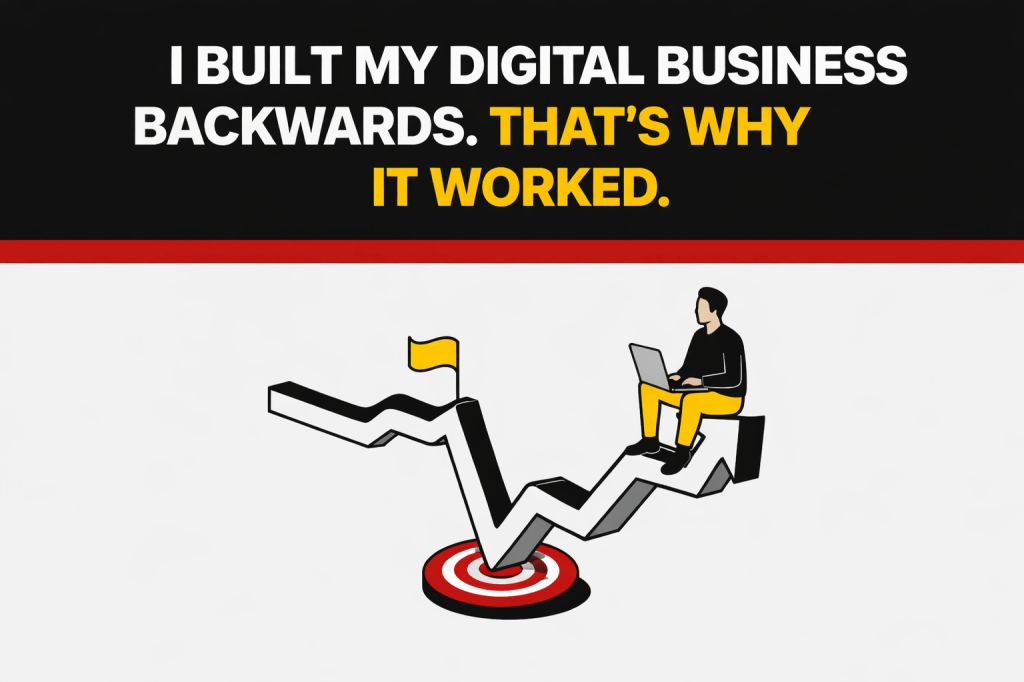
I Built My Digital Business Backwards. That’s Why It Worked.

If you’ve been “working on” your digital business for weeks—or months—but nothing is actually live yet, this is for you.

Planning feels productive. Research feels responsible. Organizing your ideas feels like progress.

But none of those things pay you.

Shipping does.

At some point, every beginner hits the same invisible wall. You’ve learned enough. You’ve consumed enough advice. You’ve refined your idea ten times. And yet nothing is published.

The problem isn’t effort.
It’s hesitation disguised as preparation.

Planning gives you the comfort of movement without the risk of exposure. Shipping forces clarity. It forces you to decide what’s good enough. It forces you to confront reality instead of staying in theory.

And that’s exactly why most people avoid it.

The digital space rewards finished work—not perfect work. You don’t build momentum by endlessly refining your plan. You build it by releasing something simple and improving it over time.

Shipping teaches you faster than research ever will.

You learn what people respond to.
You learn what feels aligned.
You learn what to fix.

When you stop planning and start shipping, everything changes. You stop feeling stuck because you’re finally moving. Even imperfect action creates feedback, and feedback creates progress.

If you’ve been waiting to feel fully ready, this is your sign. Readiness isn’t a feeling. It’s a decision.

Stop planning.

Start shipping.

New post every Tuesday and Friday.

I Stopped Following “Expert” Advice. Everything Got Easier.

For a long time, I thought I was the problem.

I wasn’t moving fast enough.

I wasn’t disciplined enough.

I wasn’t doing enough.

So I did what most beginners do — I consumed more advice.

Long threads. Frameworks. “Step-by-step” masterplans. Growth hacks. Funnel maps. Content calendars with 47 moving parts.

The more I followed expert advice, the harder everything felt.

And then something uncomfortable clicked.

The advice wasn’t wrong.

It just wasn’t built for beginners.

Most expert strategies assume you already have:

Momentum An audience Systems Confidence Time

Beginners don’t have those things yet.

When you try to operate at an advanced level without foundational systems, everything feels heavy. Every decision becomes stressful. Every task feels urgent. Every day feels like starting over.

So I stopped.

I stopped trying to “optimize.”

I stopped trying to scale something that wasn’t stable.

I stopped adding new tactics every week.

And I simplified everything.

One priority.

One system.

One clear focus.

Suddenly, work felt lighter. Progress felt visible. Follow-through stopped feeling like a fight.

It turns out beginners don’t need more expert advice.

They need fewer moving parts.

They need simple systems that protect focus long enough for momentum to build.

Expert advice works best when you’re already ahead.

Until then, simplicity wins.

If everything has been feeling harder than it should, maybe it’s not because you’re behind.

Maybe it’s because you’ve been trying to operate like someone who’s already arrived.

New post every Tuesday and Friday.

The One System Every Beginner Needs (Before Anything Else)

When you’re starting an online digital business, it’s easy to believe you need a lot of things before you can make progress. A website. A brand. Social media. An audience. A strategy for everything.

But most beginners don’t fail because they’re missing tools.
They fail because they’re missing focus.

Before funnels, platforms, or marketing plans, there’s one system every beginner needs first: a way to decide what matters right now and follow through on it.

Without that, everything else becomes noise.

When you don’t have a clear focus system, every idea feels urgent. You bounce between tasks, second-guess your priorities, and end your days feeling busy but unsure of what actually moved forward. Over time, that uncertainty turns into frustration, and motivation quietly fades.

The system you need first isn’t complicated. It doesn’t require software, automation, or a perfect routine. It simply answers three questions consistently:

  • What am I working on?
  • What am I not working on?
  • How do I know I made progress?

When those answers are clear, decision-making becomes lighter. You stop restarting every day. You stop chasing everything at once. Progress becomes visible instead of assumed.

This is why simple focus systems work so well for beginners. They reduce mental clutter and protect your attention long enough for momentum to build. Instead of trying to do more, you start doing the right few things repeatedly.

Many people think they need discipline to succeed. In reality, they need fewer decisions. When your focus is already decided, follow-through becomes easier—even on days when motivation is low.

If you’re feeling overwhelmed, scattered, or unsure where to put your energy, that’s not a sign you’re failing. It’s a sign you need a system that supports clarity before complexity.

Start there. Everything else can come later.

New post every Tuesday and Friday.

10 Beginner-Friendly Digital Business Ideas You Can Start Online Today

Starting an online digital business doesn’t require a huge audience, a complicated tech setup, or years of experience. What it does require is choosing something simple enough to start—and structured enough to follow through.

Many beginners get stuck before they begin because they assume they need the perfect idea. In reality, progress comes from starting small and building momentum. These ideas are designed to do exactly that.

Here are ten beginner-friendly digital business ideas that work well when paired with simple systems and consistent effort.


1. Digital Trackers and Planners

What it is:
Simple tools that help people track progress, habits, finances, or projects.

How to start:
Create one focused tracker using Canva or Google Sheets. Solve a single problem clearly.

Realistic income:
$50–$300/month for beginners, scalable with bundles.


2. Templates for Small Businesses or Creators

What it is:
Done-for-you templates like social media captions, email drafts, or client onboarding docs.

How to start:
Think about a task people repeat often and create a clean, reusable template.

Realistic income:
$100–$500/month once listed and promoted consistently.


3. Printable Guides or Worksheets

What it is:
Short, actionable PDFs that help with a specific task or decision.

How to start:
Turn one solution you’ve figured out into a simple guide. Keep it short.

Realistic income:
$50–$200/month to start.


4. Niche Checklists

What it is:
Step-by-step checklists for specific situations, like launching a product or organizing content.

How to start:
List the exact steps you’d follow yourself and format them clearly.

Realistic income:
$30–$150/month for beginners.


5. Email or Content Prompt Packs

What it is:
Collections of prompts that help people write faster or think more clearly.

How to start:
Create 30–50 prompts around one clear outcome, like content ideas or email topics.

Realistic income:
$75–$300/month depending on niche.


6. Simple Notion or Google Sheets Systems

What it is:
Basic systems for planning, tracking, or organizing work.

How to start:
Build a system you’d actually use yourself and keep it beginner-friendly.

Realistic income:
$100–$600/month over time.


7. Digital Business Starter Kits

What it is:
Small bundles that help beginners get started without overwhelm.

How to start:
Combine a few simple tools into one starter package.

Realistic income:
$200–$800/month with consistent promotion.


8. Printables for Life Organization

What it is:
Printable planners for daily routines, goals, or home organization.

How to start:
Design one page that solves a common frustration.

Realistic income:
$50–$250/month.


9. Educational Mini-Guides

What it is:
Short guides explaining one concept clearly, without fluff.

How to start:
Teach one thing you’ve learned the hard way, simply.

Realistic income:
$100–$400/month as authority grows.


10. Systemized Freelance Services (Digital Delivery)

What it is:
A service packaged as a repeatable system, like audits or setups.

How to start:
Turn what you already know into a structured offer.

Realistic income:
$500–$1,500/month even as a beginner.


Final Thought

You don’t need to start big. You need to start clear.

Most successful digital businesses don’t begin with perfect ideas—they begin with simple systems that make progress easier to maintain. Choose one idea, build something small, and let consistency do the rest.

New post every Tuesday and Friday.

Most Beginner Advice Is Too Complicated — Here’s What Actually Works

From Thinking to Doing: Building Systems That Actually Work S2P1

If you’re a beginner trying to build something online, advice probably isn’t hard to find. In fact, there’s usually too much of it.

One person tells you to build an audience first. Another says you need a funnel. Someone else insists you can’t succeed without a complex tech stack, daily content, and multiple income streams. The result isn’t clarity—it’s paralysis.

Most beginners don’t fail because they’re not capable. They fail because the advice they’re following is layered, unrealistic, and designed for people who are already far ahead. When everything is framed as essential, it becomes impossible to know what actually matters.

Complex advice feels productive because it sounds thorough. But complexity often hides the real problem: beginners don’t need more strategies. They need fewer decisions.

What actually works is simplicity. Simple systems give you something concrete to follow when motivation fades and attention is scattered. They remove guesswork. They narrow focus. They make progress visible instead of theoretical.

Expert strategies usually assume you already have momentum, confidence, and context. Beginners don’t. That’s why copying advanced tactics often leads to burnout instead of results. Simple systems meet you where you are and help you move forward without adding pressure.

Progress doesn’t come from doing everything “the right way.” It comes from doing the right few things consistently enough to finish them.

If most advice has been making things feel harder instead of clearer, that’s not a sign you’re behind. It’s a sign you need a simpler way forward.

This series is about clearing the noise and focusing on systems that support real follow-through—without overcomplicating the process.

New post every Tuesday and Friday.

Should You Be Further Along – Or Just More Focused?

If you’ve been feeling behind lately, you’re not alone.

It’s easy to feel that way when you’re trying to simplify. When you slow down, remove distractions, and stop chasing every new idea, it can feel like you’re falling behind everyone else who looks busy and productive.

But feeling behind doesn’t mean you are behind.

Often, it means you’ve paused long enough to notice what isn’t working anymore. It means you’re no longer running on autopilot. And that awareness is a form of progress most people never give themselves credit for.

Over the past few weeks, we’ve talked about finishing what you start, why consistency feels so hard, and why motivation isn’t enough on its own. All of those conversations point to the same truth: moving forward doesn’t require doing more. It requires doing fewer things with more clarity.

That shift can feel uncomfortable at first. When you’re used to constant motion, choosing focus can feel like standing still. But this is often the moment real progress begins.

If you’ve been questioning whether you’re doing enough, or wondering if you should be further along by now, let this be a reminder: progress isn’t always loud. Sometimes it looks like refinement. Sometimes it looks like patience. Sometimes it looks like choosing not to rush.

As we move into February, the focus shifts from understanding why things feel hard to actually applying what you’ve learned in practical, manageable ways. The next series will be about building momentum without overwhelm and creating systems that support follow-through in real life.

You don’t need to catch up.
You don’t need to start over.
You’re exactly where you need to be to move forward with intention.

New post every Tuesday and Friday.

Why Motivation Fails (And Simple Systems Don’t)

The shift that makes follow-through easier.

Motivation is often treated like the missing ingredient. If you could just find more of it, everything would finally fall into place. You’d show up consistently, finish what you start, and stop feeling stuck.

But motivation isn’t the real issue.

Most beginners don’t struggle because they lack drive. They struggle because motivation is temporary, unpredictable, and heavily influenced by how progress feels in the moment. When effort doesn’t produce visible results, motivation fades. That’s not a character flaw—it’s human nature.

Motivation works well at the beginning. It helps you start. It gives you energy when something is new. But it’s not designed to carry you through the middle, where things feel slower, less exciting, and more uncertain. That’s where most people lose momentum.

This is where simple systems make the difference.

A system doesn’t depend on how you feel that day. It creates structure when motivation is low and clarity when things feel messy. Instead of asking yourself what you should work on or whether you’re doing enough, a system quietly answers those questions for you.

Simple systems work because they reduce friction. They narrow your focus. They make progress visible. When you can see movement, even small movement, follow-through becomes easier. You’re no longer relying on willpower alone. You’re supported by something consistent.

This is why discipline is often misunderstood. People who appear disciplined usually aren’t forcing themselves every day. They’ve built simple ways to stay on track without constant decision-making. Their energy goes into execution, not into convincing themselves to keep going.

When motivation fades, systems remain. They don’t need to be complicated or perfect to work. In fact, the simpler they are, the more likely they are to be used consistently.

If you’ve been blaming yourself for inconsistency, this is the shift to make. Stop trying to feel motivated all the time. Start building small structures that support progress even on the days you don’t feel inspired.

That’s how follow-through becomes sustainable.

This post closes the Simple Systems Series, but the work doesn’t stop here. Next week, we move from understanding why things feel hard to applying simple systems in practical, everyday ways.

New post every Tuesday and Friday.

What We’ve Covered So Far — And What’s Coming Next

Over the past few weeks, we’ve been talking about something many beginners struggle with but rarely say out loud: why it’s so hard to follow through.

We started by addressing why most beginners never finish what they start. Not because they’re lazy or incapable, but because overwhelm creeps in right after the excitement fades. When everything feels important, progress quietly stalls.

From there, we talked about consistency—why it feels so difficult to maintain and why relying on motivation alone almost always leads to stop-start cycles. Consistency isn’t a personality trait. It’s something that becomes easier when progress is visible and decisions are reduced.

Most recently, we shifted focus to ideas. Not because ideas are bad, but because too many of them—without structure—create confusion. When there’s no system guiding what deserves attention, even good ideas can keep you stuck.

All of these challenges point to the same underlying issue: lack of simple support.

Not more information.
Not more pressure.
Just clearer systems that make progress easier to see and follow.

What’s Coming Next

Starting on February 3rd, we’re moving from understanding the problem to working through it.

Instead of talking about why things feel hard, the upcoming series will focus on:

-Creating simple systems that support follow-through

-Reducing decision fatigue

-Turning effort into visible progress

-Building habits that actually stick

This next phase is about doing less—but doing it better.

If you’ve ever felt overwhelmed, inconsistent, or stuck in idea overload, this series is designed to help you move forward without adding complexity.

We’re shifting from awareness to application. And that’s where things start to change.

New blog post every Tuesday & Friday. See you next time!

You Don’t Need More Ideas — You Need a Simple System

If you’re a beginner building a digital product, ideas probably aren’t your problem. Most of the time, you have too many of them.

New product ideas. New platforms to try. New strategies that promise faster results. At first, all of this feels exciting. It feels like momentum. But over time, it becomes overwhelming—and that’s where progress starts to slow.

Ideas create the illusion of movement, even when nothing is actually getting finished. You can spend hours planning, researching, and saving inspiration, yet still feel stuck at the end of the day. Not because you aren’t working hard, but because there’s no structure guiding your effort.

Without a simple system, it’s easy to jump from one idea to the next. Each new thought feels more promising than the last, so nothing gets enough attention to work. Decision-making becomes exhausting. Progress feels invisible. And eventually, frustration takes over.

This is where systems make the difference.

A system doesn’t give you more ideas—it gives your ideas a place to land. It removes the constant question of “what should I work on today?” and replaces it with clarity. When focus is narrowed and progress is visible, showing up stops feeling so heavy.

This doesn’t require complicated tools or perfect workflows. In fact, the simpler the system, the more likely it is to be used. Something that helps you focus on one priority, track progress, and move forward consistently will always outperform a complex plan that feels overwhelming.

That’s why I rely on a very simple progress tracker myself. It keeps me grounded, reduces overthinking, and makes forward movement visible—without adding more work to my plate.

If you feel stuck in idea overload, the answer isn’t another strategy or a better idea. It’s protecting your focus long enough to finish what you’ve already started.

Ideas spark momentum, but systems carry you to the finish line.

Why Staying Consistent Is So Hard (And What Actually Makes It Easier)

Everyone says consistency is the key to success.

Post consistently. Work consistently. Show up consistently.

But for most beginners, consistency feels like the hardest part of the entire process.

You start strong for a few days or weeks, then life happens. Motivation drops. Progress feels slow. And before you realize it, you’re back at square one—wondering why staying consistent feels so exhausting.

The problem isn’t that you lack discipline.

It’s that consistency is often misunderstood.

Why Consistency Feels Impossible

Consistency is usually framed as a personality trait—something you either have or don’t have.

In reality, most beginners struggle with consistency for three very practical reasons:

You’re Relying on Motivation

    Motivation is unpredictable. Some days you have it, most days you don’t. When consistency depends on how you feel, it naturally breaks down.

    Progress Feels Invisible

      When you can’t clearly see what you’ve done or what’s moving forward, your brain assumes nothing is working—even when it is.

      You’re Doing Too Much at Once

        Trying to be consistent with everything leads to burnout. Consistency works best when it’s narrow and focused.

        None of this means you’re failing.

        It means the system you’re using isn’t supporting you.

        Why “Just Try Harder” Doesn’t Work

        Most advice around consistency sounds like this:

        Wake up earlier

        Push through resistance

        Be more disciplined

        But effort without structure leads to stop-start cycles.

        If you don’t have a clear way to track progress, consistency feels like endless effort with no payoff. That’s when quitting starts to make sense.

        What Actually Makes Consistency Easier

        Consistency becomes easier when it’s designed, not forced.

        Here’s what helps instead:

        Focus on One Small Commitment

          Consistency doesn’t mean doing everything every day.

          It means showing up for one clear priority regularly.

          Make Progress Visible

            When you can see progress, momentum builds naturally. Even small wins matter when they’re visible.

            This is why simple systems—like progress tracking—work better than motivation alone. Instead of guessing whether you’re being consistent, you can see it.

            Reduce Decision Fatigue

              The fewer decisions you have to make each day, the easier it is to follow through. Systems remove the need to constantly rethink what to do next.

              Consistency Is a System, Not a Personality Trait

              People who look “naturally consistent” usually aren’t more disciplined—they’re more supported.

              They use simple structures to:

              Stay focused

              Track what matters

              Avoid overthinking

              That’s why I rely on a very simple progress tracker myself. It keeps consistency visible instead of emotional, and it removes the guesswork that leads to burnout.

              A Simple Way to Start Today

              If consistency has been a struggle for you, try this:

              Choose one thing to focus on this week

              Track whether you showed up—not how perfectly you did

              Let visibility, not motivation, guide you

              Consistency isn’t about pushing harder.

              It’s about making progress easier to see.

              Closing Thought

              You don’t need to become a more disciplined person.

              You need a system that works with you instead of against you.

              When consistency is supported, it stops feeling like a struggle—and starts feeling sustainable.